068 Unspeakable
Discussions, Asparouhova, Merton

I just checked, and it’s true, we’re still caught in this spectacular web. Many people have shared with me wishes for a revitalized world of web communications: listservs, blogs, message boards, and so on. These are text-based platforms that may have been open or gated (or moderated), and that allowed for short as well as as long form text at people’s discretion, gratis, without algorithmic nudging, with little or no advertising. I don’t think the major, subsequent social media platforms today satisfy those conditions.1 All of these older forms still exist, mind you, but the place they have in online discussions is diminished. And one can have good discussions on the major social media platforms, but such conversations are clearly the exception. However many times I hear (even from a voice in my own head), “it would be great to have in-depth discussions online like we used to,” I am still hesitant to do something about it myself, and I remain slightly bearish on any others’ attempts to do likewise.
Why? The biggest change, as I see it, and the biggest obstacle to the task of reinvigorating various discussion platforms that some people sincerely want back, is the information environment. Circa 2005, social media as we later came to know them were in their infancy, and if people used the internet to establish their elsewhere communities, they would often use such things as, yes, listservs, blogs, and message boards. But now we’ve amassed an exhausting generation’s worth of social media wreckage. We are all inescapably living in a world shaped by Facebook/Meta, Instagram, Tiktok, Twitter/X, and countless apps. Because we are often obligated to participate in this world in some form, or to understand that most of the people around us are participating, and because phone apps have supplanted a large chunk of larger-screen web browsing, it is more difficult to find the time and resources to read and write in the ways that the slightly older forms of elsewhere community took.
I’ve been thinking about how to bridge certain gaps or meet certain demands, then, re: open, long-form, substantive text discussions within groups, while remaining attentive to years and generations of change—changes that have to do with technology, yes, but also spiritual or cultural disquietude.
Conversations and approximations of conversations still occur. Obviously. However, in the decrease of higher quality group discussions that capitalize on these affordances, people have often moved into less public, less archived, or less accessible communications. There are things unsaid, or said sotto voce, that point to a widespread dissatisfaction. Two books I’ve read this year shed some light on this. One is new and the other is a little less new.
Nadia Asparouhova is a thoughtful and probing writer on contemporary internet culture and related areas. I appreciate the way she tackles problems top-to-bottom in her extended pieces. A lot of Silicon Valley or rationalist/postrationalist types take “thinking from first principles” as a license to reinvent the wheel, over and over, and consequently do or believe many dumb things that are only “justified” via spreadsheet-flowchart substitutions for actual thinking. This does not apply, however, to the patient, observant research and musings of Asparouhova.
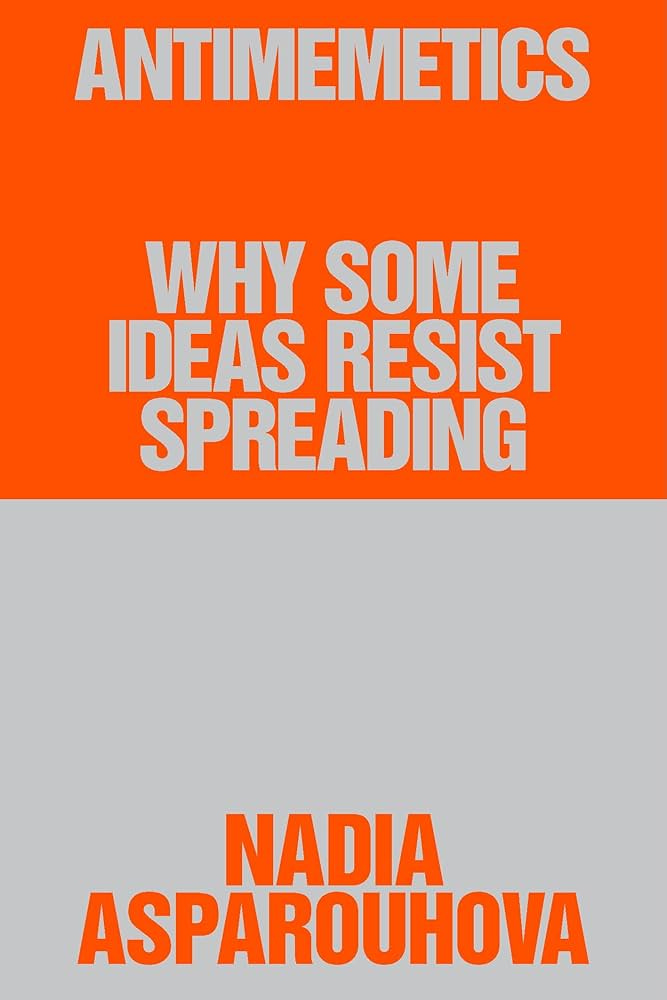
Antimemetics: Why Some Ideas Resist Spreading (Dark Forest Collective, 2025) explores the shadow side of how memes have shaped discursive behaviors. Whereas memes spread through virality (exposure is good! we want more visibility! replication is desirable!), antimemes are slippery, resist containment or measurement, and skew toward the private and the gated. As I think of it, memes are tempered and strengthened through enduring publicity, with a spotlight, and antimemes emerge wherever the bright public lights cast shadows in the memetic ecosystem. They are also a “defense mechanism” against cognitive overload, including the burden of heavy or official truths (and untruths).
(NB: Though Girard’s theory of mimetic desire makes an importance appearance in the book, I’ll echo Asparouhova’s note for the reader—she’s writing about (anti)memetics, e instead of i there.)
Antimemes might be cultural taboos or “uncomfortable truths,” whisper networks, open secrets, hidden languages; antimemes may be information that is socially unsafe to know or to speak, or simply information that doesn’t seem to fit in more public, visible, or durable paradigms. (Asparouhova cites the persistence of Daylight Savings Time in the US—a policy that almost no one seems to like—as an example of how difficult it can be to sustain and act on antimemetic thoughts. Calls to end DST consistently fizzle out because attention shifts elsewhere after little spikes of focus twice a year, other priorities crowd it out.) People guard the expression of some of their thoughts, or silo it, or forget it, unless and until there are inflection points after which some dormant/popular ideas suddenly burst into fuller public view in the wake of a new situation, or people who function socially as “truth-tellers.” (There are similarities here to what Timur Kuran calls a “preference cascade.”) Asparouhova’s book is not an endorsement of any particular political position and she does not link antimemetics intrinsically to any faction; this is simply part of how everyone partakes in the current attention economy. Thus, even a designation like “truth-teller” should be read as a functional description; a “truth-teller” in this memetic/antimemetic environment is not necessarily someone who tells what Asparouhova, or any individual, would call Truth, but a trailblazer who plays a role in the reorganization of previously de-emphasized and hidden ideas.
Asparouhova highlights a moment, years ago, when the second active shooter in a week roamed the San Francisco neighborhood where she worked. She, concerned and anxious about the threat of violence, messaged her co-workers, “Wow, what’s up with our neighborhood lately?” and received responses about how the shooters suffered a lack of resources and many hardships, they deserved good wishes, etc. Embarrassed, she responded apologetically. “I didn’t know it was a faux pas to express fear of active shooters at the workplace, instead of empathy for those who might be trying to kill me.” Whether a person “relates” to this response or not, one can see how there are always things one might want to say, or even ask, that seem harmful or at least socially “expensive” to express.
“Antimemetic ideas often grow within dense, high-context networks.” For instance, antimemetic chatter occurs when there’s a group text thread among co-workers complaining about a new corporate policy that, in meetings and in hallways, everyone seems to embrace. The riffing grows out of a highly contextualized understanding of voice and audience. At the very least, haven’t you ever nudged someone trustworthy next to you and whispered, “Is it just me or …?”
I’m providing only a selective and high-level gloss on the book, which is short and easy to read, but idea-dense. In addition to describing the phenomenon and the conceptual basis of antimemetics, Asparouhova also points to some practical advice regarding attention. When Asparouhova departs from the example of Jenny Odell (“how to do nothing”) because she doesn’t want her agency to be defined in a constant stance of friction or opposition—instead she wants to move more nimbly, “from a place of ease and confidence.” I think that’s important; refusal and non-participation are valuable tools but I suspect it’s more helpful long term to think less of critical defiance and more of positive agency. We have to learn how to see through things, see what’s not otherwise legible to our systems, work within and without them.
While Antimemetics offers an insight into how the dynamics have come to be and how they manifest and what one might want to do about them, I think it may be the task of other books to “connect” with her theory and deepen the sense of what to do with these practical tools and why to do those things with them. One such book, for me, was published over fifty years ago.
There’s a very good chance you know who Thomas Merton was. For those who don’t, he was a Trappist monk who wrote many excellent books and essays, and died at age 53, from a bathtub electrocution, in Bangkok in 1967, in the middle of a long journey to learn more about Asian religions and religious practices and to open up further dialogue between “East and West.” Charismatic and worldly in character, Merton spent his adult life trying to run away from profane celebrity, to live a life of contemplation and adoration of God. One does not have to be a Catholic, or a Christian, or a believer in any particular creed to benefit from his writing, though so much of his work quite explicitly grapples with what it means to follow Christ in the contemporary world.
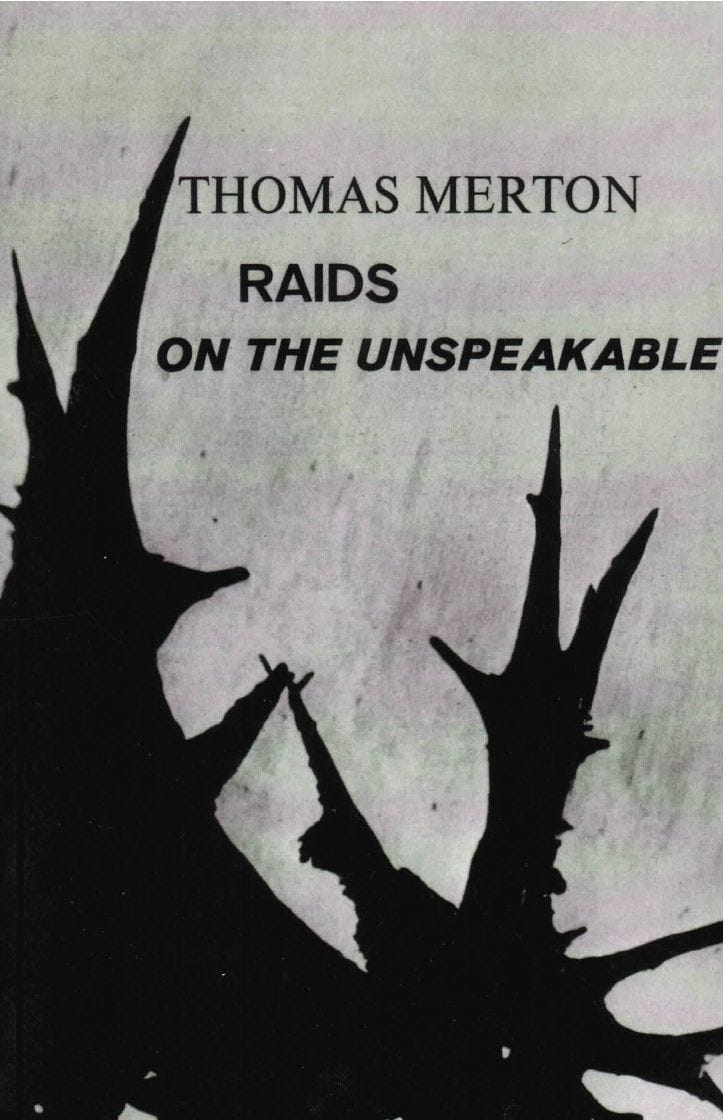
In the 1960s Merton released Raids on the Unspeakable, a loosely interwoven collection of essays that stand out from much of his other work because (as the author himself puts it), this book hadn’t necessarily “been to seminary.” He cites a special affection for this oddity; it doesn’t seem to fit in or fit any easy classification. One of the key topics is the nature of reality, or more precisely, the reality that isn’t—cannot be—measured, marketed, or proclaimed by authority.
“The Unspeakable. What is this? Surely, an eschatological image. It is the void that we encounter, you and I, underlying the announced programs, the good intentions, the unexampled and universal aspirations for the best of all possible worlds. It is the void that contradicts everything that is spoken even before the words are said; the void that gets into the language of public and official declarations at the very moment when they are pronounced, and makes them ring dead with the hollowness of the abyss. It is the void out of which Eichmann drew the punctilious exactitude of his obedience, the void which drawls in the zany violence of Flannery O’Connor’s Southerners, or hypnotizes the tempted conscience in Julien Green. It is the emptiness of “the end.” Not necessarily the end of the world, but a theological point of no return, a climax of absolute finality in refusal, in equivocation, in disorder, in absurdity, which can be broken open again to truth only by miracle, by the coming of God.”
In the opening essay, Merton describes the rain outside his cabin:
“Let me say this before rain becomes a utility that they can plan and distribute for money. By “they” I mean the people who cannot understand that rain is a festival, who do not appreciate its gratuity, who think that what has no price has no value, that what cannot be sold is not real, so that the only way to make something actual is to place it on the market.”
Merton listens to the rain because it reminds him that the world moves according to rhythms he has “not yet learned to recognize.” This overpowering rhythm he contrasts to the way of life of “the city,” which is not quite meant literally, but rather names the posture of existence which refuses to learn to recognize the rhythms of the rain (and everything else). The people of the city might have some faint inkling of the existence, the reality, of the rain, but they are consumed by their various obsessions, instead. They are enthralled to what Merton calls a basic lie: “only the city is real.” Throughout the book’s essays, which take different tones and forms, there is a motif of an escape. In one of the most moving passages, Merton explores the theme of “mercy” and contrasts it with “obsession.” An obsession overwhelms and compels; mercy sets free—it is a gift, superfluous, lawless, extra. “Law is consistent. Grace is “inconsistent.”” All that is SERIOUS, official, powerful, i.e., bloodthirsty, cancerous, domineering can come undone in an instant. But it represents an entirely different perception of the world’s (ir)reality, and it entails some separation from the demands placed upon one’s attention by the world.
Both Asparouhova’s explanation of antimemetics and Merton’s notion of the unspeakable refer to perceptions of realities that are illegible, or marginal, to the totalizing operations of the world we might call (though neither Asparouhova nor Merton do) the spectacle, after Guy Debord. They involve attention that is, in a sense, “misplaced.” Asparouhova is theorizing the activities and behaviors that actually happen in the contemporary (online) world; the private group chats and whisper networks. Merton, meanwhile, pre-internet obviously, addresses a public of individuals who are there reflecting before their own consciences. Let me quote him some more, and at some length, because in three paragraphs he provides a compelling explanation for why the world disorders the self in the way that it does, which I suspect may expand our understanding of Asparouhova’s diagnosis of cognitive overload and conspiratorial open secrets, a condition which tries to deny personal need and to elevate belonging in a worldly authority:
“Such is the ignorance which is taken to be the axiomatic foundation of all knowledge in the human collectivity: in order to experience yourself as real, you have to suppress the awareness of your contingency, your unreality, your state of radical need. This you do by creating an awareness of yourself as one who has no needs that he himself cannot immediately fulfill. Basically, this is an illusion of omnipotence: an illusion which the collectivity arrogates to itself, and consents to share with its individual members in proportion as they submit to its more central and more rigid fabrications.
“You have needs, but if you behave and conform you can participate in the collective power. You can then satisfy all your needs. Meanwhile, in order to increase its power over you, the collectivity increases its needs. It also tightens its demand for conformity. Thus you can become all the more committed to the collective illusion in proportion to becoming more hopelessly mortgaged to collective power."
“How does this work? The collectivity informs and shapes your will to happiness (“have fun”) by presenting you with irresistible images of yourself as you would like to be: having fun that is so perfectly credible that it allows no interference of conscious doubt. In theory such a good time can be so convincing that you are no longer aware of even a remote possibility that it might change into something less satisfying. In practice, expensive fun always admits of a doubt, which blossoms out into another full-blown need, which then calls for a still more credible and more costly refinement of satisfaction, which again fails you. The end of the cycle is despair.”
Merton’s words also call to mind for me Ivan Illich’s warnings about the manufacture of dependencies. If Antimemetics is a useful map for the information environment we’re always wading through, Raids on the Unspeakable anachronistically serves to enhance and amplify the call that Asparouhova makes to attend to our own attention. We do not simply want to “ignore” or “oppose,” but to do the thing that is superfluous, that breaks the rules, that moves in between, and attends the festival.
Whenever possible, we remember to live in the rain, not in the city.
I’ll try to keep that in the back of my mind, as I keep going.
Even Substack, to me, is most helpful in the sense that it is basically just a blog, or a modified one-to-many listserv. The social media app aspect of it feels much too embedded in the algorithmic system to be really useful. Spotify is similar: sure, maybe you’ll encounter something good from what the platform presents you with next based on your “activity,” but it’s more likely over time you’ll be presented with a slop-approximation of an outside view of your taste. Standardization and differentiation. (Do Reddit or Discord suffice for all that’s missing? Hmm.)
This reminds me of Hayek's concept of tacit economic knowledge.
An associate to Asparouhova classifies antimemes in three categories:
-weak antimemes: taboos or similar social phenomena.
-strong antimemes: cannot be represented with language, either verbally, written, in code, or with any other existing symbols, but can be communicated non-linguistically through practice, or vaguely explained linguistically with metaphors.
-a fundamental antimeme cannot be cognitively represented at all in Homo sapiens brains.